The Fourth Wall Became the Cage
An essay on how Brechtian distance has been inverted by streaming culture, where irony, fourth-wall breaks, and meta-awareness now intensify immersion rather than interrupt it.

On the inversion of Brechtian distance under the conditions of the streaming feed
A prestige drama opens with the protagonist turning to the camera and remarking, drily, that what follows will be the kind of thing the viewer expects from a prestige drama. The line lands. The viewer laughs, settles deeper into the cushion, refills the glass, and watches six more hours. The gesture of breaking the frame, far from cooling the absorption, has warmed it. The viewer has been flattered by the show's knowingness, has been promoted from passive consumer to co-conspirator, has been issued, in the opening minute, a small badge that reads I see what you are doing and I approve. The badge is the binding agent.
This was not how the technique was supposed to function. The German playwright who gave the technique its name, working in the years between the wars, designed it as a counter-procedure against precisely the absorption the modern viewer now sinks into. The actor was to step out of the role. The placard was to announce the scene before it was played. The song was to interrupt the action. The lighting rig was to be visible. Every device of stagecraft was to be exposed as a device, so that the spectator, denied the warm bath of identification, would be returned to the cool upright posture of judgement, and would leave the theatre not weeping but thinking, and not thinking vaguely but thinking about the political conditions the play had laid open. The estrangement was the labour. The labour was the point.
For his century the procedure was correct. The bourgeois theatre of the nineteenth century had perfected an apparatus of identification, the proscenium arch, the darkened house, the orchestral cue, the realist set, all of it conspiring to dissolve the spectator into the fate of the protagonist and to send him home reconciled to a fate that was, in truth, contingent and changeable. To interrupt that dissolution was a serious act. To put a card on the stage that read Here is the man being hanged for stealing bread because the bread is owned was to refuse the catharsis and to keep the political wound open. The cool spectator was the awakened spectator. The awakened spectator was, in principle, the citizen who might act.
Our century has inverted the procedure without retiring its vocabulary. The devices remain, the placard, the address to the camera, the visible rig, the song that interrupts, the actor commenting on the role, the showrunner appearing in his own credits sequence. The devices remain and their function has been reversed. They no longer break the spell. They are the spell. The spectator who watches the protagonist turn to the lens is not estranged from the fiction; he is more bound to it than he would be by any naturalist tableau, because he has been granted the additional pleasure of feeling cleverer than the fiction while consuming it.
The Reflex Turned Ornament
What has happened is that estrangement, the device, has been severed from estrangement, the cognitive event. The device proliferates. The event does not occur. A sitcom character looks into the camera and raises an eyebrow at the absurdity of his own situation, and the absurdity is not made strange, it is made cosy. A blockbuster jokes about the conventions of the blockbuster while obeying every one of them. A streaming series breaks its own fourth wall to acknowledge that fourth walls are broken now, and the acknowledgement is the only wall that matters, because it is the wall the viewer cannot see past. The meta-frame is the strongest frame. Distance has become garnish.
The mechanism is precise enough to be named. The gesture of seeing through the fiction is offered to the viewer as a gift inside the fiction. The viewer accepts the gift. In accepting it, he believes himself to have stepped outside the apparatus that has just handed him a token of exteriority. He has not stepped outside. He has been given a souvenir of an outside that does not exist, and he has paid for the souvenir with the same attention he would have paid for naive immersion, and the souvenir is more expensive because it carries the surcharge of flattery. Name the operation, name the laundering, name what the laundering conceals. The operation is reflexivity. The laundering is the conversion of reflexivity into adhesion. What is concealed is that the cooled spectator is the captured spectator, and that the cooling itself is the capture.
This is not a marginal mutation. It runs from the lowest comedy to the highest prestige. The mockumentary, with its handheld camera and its acknowledged crew, was the test bed; the form taught a generation that the visible apparatus was a sign of authenticity rather than of artifice, and so the apparatus, once visible, became another kind of invisible, because nothing announces itself more confidently than the thing that pretends to confess itself. The auteur cameo, the credits joke, the title card that names the trope it is about to perform, all of these belong to the same architecture. The architecture is one in which knowingness is the new immersion.
Why the inversion was available
The playwright could not have foreseen this, but the seeds of the inversion are visible in retrospect, and the diagnosis is not a betrayal of his project but a continuation of its honesty. He assumed a spectator who was not yet ironised. He assumed a culture in which the dominant register was sincerity, in which the realist illusion was the default, in which to interrupt the illusion was to commit an act of impolite cognition that the spectator would have to metabolise. He did not foresee a culture in which irony would become the default register, in which sincerity would be the rare and embarrassed exception, in which the interruption of illusion would arrive not as a shock but as a confirmation of the spectator's pre-existing sophistication.
In such a culture the alienation device performs the opposite of its original function. It does not awaken the spectator from absorption; it absorbs him through the door marked awake. The door is marked, the door is well lit, the door is much used. Through it pass the viewers who would never have submitted to the old illusion, who consider themselves above the rubes who weep at melodrama, who require their fictions to acknowledge their own fictionality before they will agree to be moved by them. They are moved nonetheless. They are moved more efficiently, because the ironic preamble disarms the critical faculty by appearing to flatter it, and a critical faculty that has been flattered is a critical faculty that has been put to sleep.
A counter-thinker is useful here. The Frankfurt theorist who worked alongside the playwright, and who suspected even in the 1940s that the culture industry would absorb every avant-garde gesture by reproducing it as style, saw further on this point than his collaborator. He understood that the dialectic between form and content could be neutralised by the simple expedient of treating form itself as content, of making the formal disruption into the new genre convention. What was once a wound in the surface of the work becomes a feature of the surface. The placard becomes the title sequence. The visible rig becomes the behind-the-scenes featurette. The actor commenting on the role becomes the press junket bleeding into the film. There is no longer an outside from which the interruption might come, because every possible outside has been pre-installed as an interior amenity.
The Case of The Prestige Protagonist
Consider the figure who has dominated serial drama for two decades, the morally compromised antihero whose creator regularly reminds the audience, through narrative device and through extra-textual interview, that the audience is not supposed to identify with him. The reminder is constant. The reminder is sincere on the part of the showrunner. The reminder fails. It fails because the reminder itself is part of the pleasure of watching the antihero, because the viewer who is told do not identify is given a license to identify with an additional ironic layer of self-awareness laid over the identification, and that layer is more flattering than naive identification would be. He gets to want what the antihero wants and to know that wanting it is wrong, and the knowing converts the wanting into a refined wanting, a wanting that has read the criticism, a wanting that has done its homework.
The estrangement device, in this case the showrunner's own meta-commentary, has become the mechanism by which absorption is intensified. The viewer who has been warned not to identify identifies more deeply, because his identification now contains a self-reflexive proof of his own sophistication, and sophistication is the modern form of permission. The placard has been turned around. It used to read the man is being hanged because the bread is owned. It now reads you are sophisticated for watching the man be hanged, and we are sophisticated for letting you watch, and the bread, well, the bread is complicated.
The political wound the playwright wanted to keep open has been sealed with a balm made of self-congratulation. The balm is more effective than any old narcotic of identification could have been, because it numbs not the cognitive faculty but the cognitive faculty's own awareness of being numbed. The viewer believes himself to be thinking. The thinking has been pre-packaged. The pre-packaging is the thinking he believes himself to be doing.
None of this means the original procedure was wrong. It means the procedure was correct for a culture that no longer exists and that the procedure's name has been taken up by an industry that uses it for opposite purposes, and that anyone who still wants what the playwright wanted, the awakened spectator, the cool upright posture of judgement, the political wound kept open, must now find a different procedure. The visible rig will not do it. The address to the camera will not do it. The actor stepping out of the role will not do it. These have all been absorbed, branded, monetised, turned into the very binding agents they were designed to dissolve.
What might still do it is harder to name and harder to perform, because any procedure that becomes nameable becomes, within a season or two, the next style. Perhaps it lies in refusals rather than gestures. The refusal to provide the ironic preamble. The refusal to flatter the viewer for having shown up. The refusal of the wink. A work that does not acknowledge its own cleverness, that does not pre-empt its own critique, that does not offer the viewer a seat at the table of its own production, leaves the viewer with the older and harsher possibility of having to judge it without being told in advance how. This is closer to what the playwright wanted than any number of placards. The placard, after all, was never the point. The cool spectator was the point.
The culture has learned every trick except one. It has not yet learned how to handle a work that takes itself seriously without irony and refuses to take its audience into its confidence. Such a work appears, when it appears, almost rude. It does not perform its own knowingness. It does not wear its devices as jewellery. It assumes the spectator can do his own thinking and declines to do the thinking for him in advance. It is, in its refusal of the meta-frame, more alienating than any visible rig, because it returns the spectator to the position from which judgement actually proceeds, the position of not having been told what to feel about what one is being shown.
The Diagnosis
The device has outlived the cognition. The wink has replaced the wound. A century after the placards were hung above the German stage to keep the spectator's mind open against the closing pressure of bourgeois identification, the same placards have been refitted as the closing pressure itself, and they close more tightly than identification ever did, because they close around the part of the mind that believed itself to be open. The cool spectator is the captured spectator. The spell of distance is the strongest spell. What was once a procedure for awakening has become the most refined procedure for keeping the awakened asleep.
Subscribe to access work from a collective of independent minds producing essays, ideas, and cultural projects grounded in depth and precision.
Written by Bailey Booth
The Social Theatre is Available worldwide purchase below.
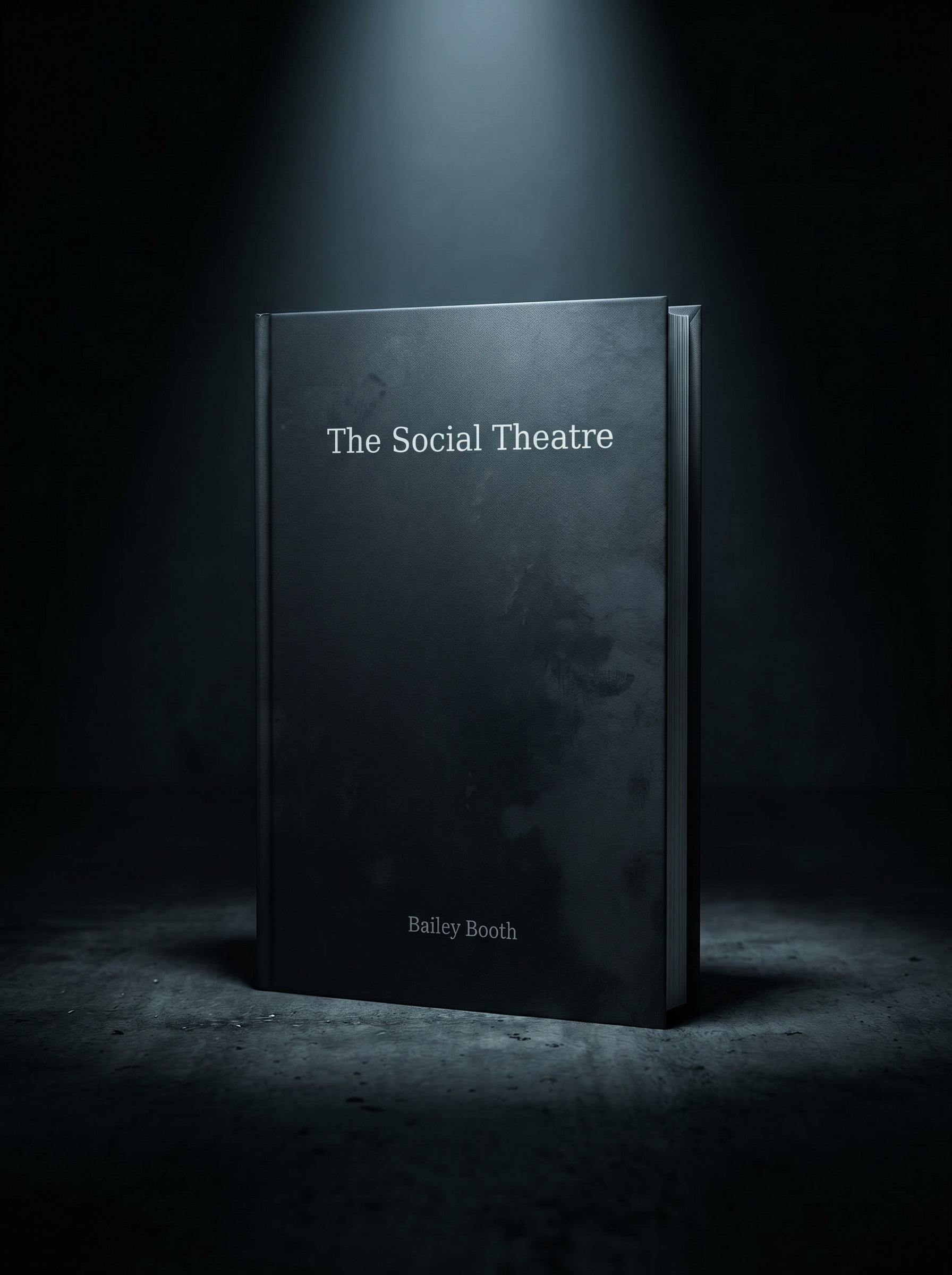
The Social Theatre: An Anatomy of Modern Roles, Masks and Civilizational Performance
The Social Theatre is a philosophical anatomy of civilisation as performance.
Modern society likes to imagine itself as the triumph over barbarism: lawful, rational, moral, enlightened. Bailey Booth begins from a darker premise. Civilisation has not abolished barbarism. It has redistributed it through uniforms, institutions, rituals, professions, punishments, spectacles and respectable masks.
Across four sections, Booth examines the roles modernity produces, rewards, condemns and hides: the police officer, the soldier, the bureaucrat, the warden, the judge, the beggar, the thief, the addict, the artist, the prisoner, the serial killer, the politician, the influencer, the philosopher, the priest, the journalist, the academic, the citizen and modern man himself. Each figure is treated not as an isolated type, but as a performance staged by the same symbolic machinery that governs contemporary life.
This is not a work of comfort. It offers no innocent observer, no pure moral centre, no position outside the system from which the reader may safely judge. In The Social Theatre, the roles precede the actors, the masks precede the faces, and the audience is already implicated in the performance it believes it is only watching.
Moving through authority, marginality, violence, deviance, respectability and obedience, Booth exposes the hidden continuities between the figures society calls monstrous and the figures it calls civilised. The argument is not that these roles are the same, but that they are produced, staged and sustained by the same civilisational order.
Dense, uncompromising and confrontational, The Social Theatre is written for readers of philosophy, sociology, political theory, psychoanalysis, cultural criticism and critical theory who are prepared to face modern life without consolation.
The curtain has already risen.
You have been on the stage throughout.