Echoes
Baudelaire's Correspondances against the materialist rupture: nature as language, metaphor as transit, meaning beyond literalness.

In Nature's temple, living columns rise,
Which oftentimes give tongue to words subdued,
And Man traverses this symbolic wood,
Which looks at him with half familiar eyes,
Like lingering echoes, which afar confound
Themselves in deep and somber unity,
As vast as Night, and like transplendency,
The scents and colors to each other respond.
And scents there are, like infant's flesh as chaste,
As sweet as oboes, and as meadows fair,
And others, proud, corrupted, rich and vast,
Which have the expansion of infinity,
Like amber, musk and frankincense and myrrh,
That sing the soul’s and senses’ ecstasy.
Translated by Cyril Scott
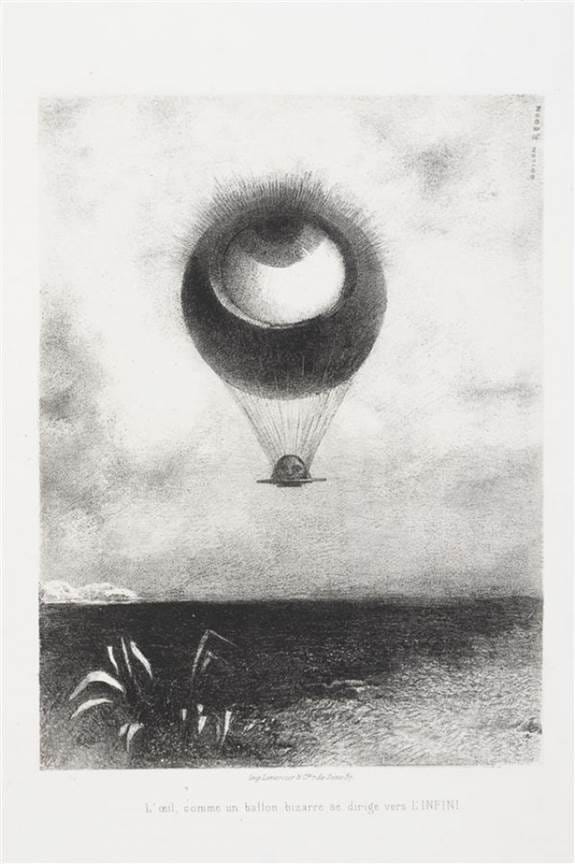
The Eye, Like a Strange Balloon, Mounts Towards Infinity, Odilon Redon
In this poem by French poet Charles Baudelaire, there is a communication of an interesting metaphysics of correspondence. We can oppose the metaphysics of correspondence to the metaphysics of rupture. Baudelaire attributes mental and linguistic powers to a forest. The forest strangely knows us, and communicates through symbols. There is a reciprocal echo between the various senses, and the interior life of the poet, forming a vast unity.
A metaphysics of correspondence views the outer and the world as united. Mind is not something on the periphery, facing what is not mental. A metaphysics of rupture views the inner and the outer worlds as radically distinct. The outer world is dead, mentally and spiritually speaking, and meaning and value reside only in the mind, in isolation. I think a metaphysics of rupture underlies much of our modern malaise.
Do natural things echo our human attempts to communicate? We have eyes taking in experience and tongues that reflect that experience in words, but natural things seem self-enclosed in perpetual darkness, not reaching out to their environment in efforts to communicate. In Baudelaire’s poem Correspondances, he presents a forest as a living temple. It is not just mute stuff, but a spiritually infused entity. The forest is animated, with a mysterious capacity for knowing, and acts as a conduit to what is sacred. There is a rejection here of a conception of nature as merely a dead machine. There is a rejection, in other words, of a dualism that separates mind from nature. In this dualistic picture, the private world of the mind looks out on an absurd world that has no mind. Instead of this rupture between mind and world, this poem shows correspondences, in which mind embraces both the interior and the exterior world of nature.
Have you ever walked through a silent forest, and felt mysteriously known by the pulsing life around you? The constant stimuli in our modern world hide this eloquent silence around us. Baudelaire’s poem is a meditation on the symbolism in nature. Nature does not consist in just literal things, but constitute a kind of language.
The materialist reduces nature to mute stuff. Materialism is the position that matter is the fundamental reality, rather than mind. For the materialist, raw physical stuff is the first reality, which later gives rise to mind.
The opposite view is that mind generates matter. This is the kind of view we find in major religions. If matter emerges from mind, it is a kind of language. Matter is an emanation of mind, and so follows a deliberate logic. This is the underlying theme of this great poem by Baudelaire. The forest knows the poet, looking at him with half-familiar eyes as if it were conscious, because the ultimate ontological roots of the forest rest in mind. Just as the human mind uses words to communicate its thoughts, the original mind of the universe generates matter from its thoughts. Things are not just things, but symbols.
If, on the contrary, matter is ultimate, it speaks no language. Mind emerges from it accidentally, since matter by itself can plan nothing. Matter is simply stuff whirling around according to natural forces. For the materialist, deliberate and intelligent language is an aberration. Language is of the mind and separate from nature, which is mindless organic machinery. Materialism has roots in ancient Greek atomism which views reality as just complex arrangements of randomly colliding atoms, without mental direction. In this materialist outlook, mind is a freakish aberration. Out of purposeless mindless particles, we get a sensitive consciousness capable of organized experience. There is a massive rupture between raw stuff and the linguistically acute mind. Humanity is a lonely absurdity in a world that cannot possibly anticipate humanity.
Baudelaire’s poem, Correspondances, rejects this rupture between consciousness and raw stuff. Nature, instead of being mute, expresses a kind of language. Nature is a temple, an opening to what is sacred. Nature emits confuses paroles, i.e. indistinct utterances. No one maintains that nature communicates like a human being. We do not approach a tree or an animal and have conversation, like characters in a fairy tale. We do not text God on our phones. The speech of nature is mysterious and obscure. It requires deep interior work to hear it. Most people are deaf to it. To hear the fitful speech of nature requires a silencing of human chatter.
Baudelaire views natural things as symbols (symboles). A tree is not just a tree, but communicates multiple levels of reality. We use natural objects to communicate interior realities all the time. Trees represent stability and calm strength as well as vibrancy. They are not just trees but symbols of the interior life. Water represents change. Nature is not just raw stuff separate from mind but an expressive palate intermingled with our consciousness.
The speech of nature unites the mind with matter. People’s bodies are not just crude matter but communicate interior reality. Body expresses mind. Faces and bodies represent interior beauty and depravity alternately. Baudelaire senses a cosmic oneness in the second stanza, a profonde únite that unites both mind and matter. This worldview is very different from the radical dualism we get in figures like Descartes, who considers the material world to be merely mechanical, consisting in operations devoid of thought.
Poetry, I think, relies on a unity of the material and the interior reality of the spirit. What is that separates poetry from prose? Prose tries to be as clear and literal as possible. When I use prose to describe a tree, I want you to have as clear of an idea of that tree, in all its concrete literal particularity, as possible. But, poetry elevates the concrete by intermingling it with the abstract. The tree is no longer just a tree, but part of an interaction between body, mind, the external world, and the soul. The tree becomes a reference point and a bridge to higher considerations, beyond its material embodiment.
Metaphor comes originally from the Greek word, μεταφορά (metaphorá). Meta is not just a tech company, but also means “beyond.” Metaphors point beyond the surface level reality, by connecting a concrete reality to interior significance. A tree can be a metaphor for continual stability. The mother is as strong as a tree. There are correspondences or echoes, as this poem points out, connecting the surfaces of things and the depths of human interior lives. A tree echoes an inner fortitude in an external manner.
In the third stanza, Baudelaire uses the rhetorical figure of synesthesia. This is a combination of independent senses. We typically do not associate, for instance, a color and a sound, but we can do so in poetry in ways that make sense. A scream can be yellow—this makes sense in a weird way. In Baudelaire’s poem, perfumes are sweet, like the sound of an oboe. Perfumes are green, like a prairie. Here, we combine scent, sound, and vision.
Again, the message has to do with the metaphor, which bridges different sensations that seem initially disparate. There is a unity instead of rupture, that transfers or carries beyond (meta) one sense into another. Reality is multi-valent rather than literal, united rather than divided. Things refers to other things, the inner refers to the outer, body refers to mind.
The narrowly quantitative and discriminating mind needs to separate one sense from another, and cannot tolerate metaphor that connects layers of meaning. Someone considering a plot of land for its potential productivity cannot tolerate the ambiguity of metaphor. Land for purchase cannot also have an interior significance, since this would confuse the measure of its value. The modern materialist is transactional. A tree is good for what it can yield, not for any higher significance, and it reduces to numbers, in a calculation of profit.
Why is the modern materialist so jaded? People find life boring. But, Baudelaire in this poem speaks of transports de l’esprit. That is, there is a kind of ecstatic movement out of oneself, in contemplating nature. We on the contrary are bored, because we view everything as literal. Literalness is needed for transactions in the workaday economy. In buying something, I need to know exactly what I am getting, not its metaphorical associations. But, this reductive view misses a chance to elevate the soul, by treating nature as a symbolic transition to higher realities.
The literal-minded person fails to see correspondences, between his own ideas and things in the world. This generates a solipsistic boredom. What is meaningful takes place only in the mind. The mind gives meaning to what is in itself meaningless. Meaning is only constructed, by our attempts to give value, and is not a reciprocal affair between the world and the mind.
Baudelaire’s poem, Correspondences, rejects this dry mentality. Meaning is both inside and outside the mind. Meaning beats in the heart of nature, which points beyond itself to a higher reality. The senses are not windows into a soulless mechanical domain of atoms in flux. Instead, the senses are windows into a higher soul, meeting our own at the intersection of nature and the senses.
Written By Daniel Dal Monte.
 Substack

Subscribe to access work from a collective of independent minds producing essays, ideas, and cultural projects grounded in depth and precision.