Explore the evolution of computation from early mechanical devices to the breakthroughs of Babbage, Boole, and Von Neumann that shaped modern computer science.
One meaning of the word "computer" is "calculator," "one who computes." Accordingly, the history of computation should refer to objects capable of performing calculations, in the sense of automatically performing arithmetic operations. Thus, in a generic sense, the term "computer" is used to designate a device that is provided with input data and from which we expect a result, that is, output data.
The level of automation and the complexity of the operations performed are two key factors in the development of computation. The enormous difference between having to move the balls of an abacus by hand and having this operation performed by electromechanical devices marks an undeniable technological advance. Whether the device in question is designed to perform multi-digit sums or is capable of solving differential equations is also a technical question, albeit of a different nature.
Unlike science, where the contribution of a single individual can produce a surprising result, in technology development is usually slower and occurs gradually. Producing mechanisms with gears, axles, and couplings requires not only adequate design but also a factory capable of producing the parts. This is why the famous analytical and differential engines of the British computational scientist Charles Babbage (1791-1871) were doomed to failure. Ample proof of this is the fact that today, perfectly functioning Babbage machines have been built for museum purposes.
Despite this, these machines are considered the cornerstone of the mechanical age of computing, especially when viewed in conjunction with the presence of the British mathematician Ada Augusta Byron (1815-1852), Countess of Lovelace, responsible for the first programming language in history, which led to the emergence of a crucial element to consider in the evolution of computation, what we currently mean by "software." From then on, the computer became hardware and software.
From this point of view, it is worth highlighting the 1854 publication of An Inquiry into The Laws of Thought by the British mathematician George Boole (1815-1864), a work that marks the birth of the so-called "Boolean algebras", a new algebra of logic in which variables can assume only two values, 0 and 1, and in which three fundamental functions operate: AND, OR and NOT, on the basis of which the future logic gates of modern computers would be built.
In the era before the various generations of computers, it is necessary to mention the year 1801, the date in which the automatic loom of the French merchant Joseph Jacquard (1752-1834) appeared, based on a series of punched cards capable of storing certain information about repetitive processes.
The beginning of the new generation of computers is usually dated 1890, coinciding with the population census commissioned by the United States government, which was scheduled to last ten years. With Herman Hollerith's (1860-1929) device, based on Jacquard's punched cards for the hardware and Boolean algebras for the software, the census lasted only two years. Shortly after the completion of this work, the first company dedicated to the production of this type of calculating machine, the International Business Machine Corporation, was founded in 1924.
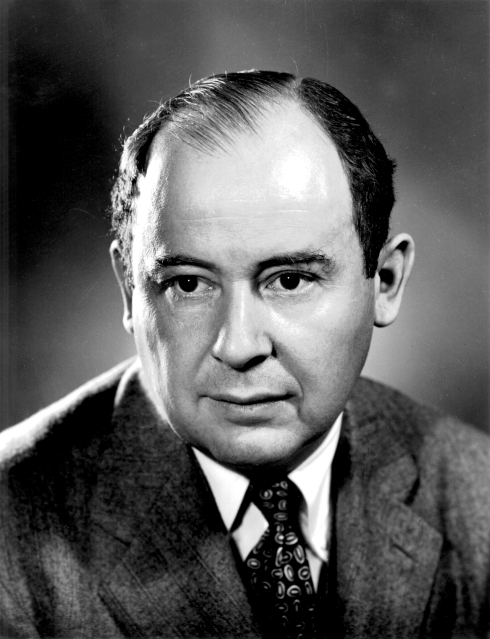
Von Neumann introduced the use of punched cards in the first mathematical calculations with computers. His brother Nicholas recalled that the idea came to him during a conversation they had at the dinner table, when they still lived in their parents' home in Budapest. Often in these family conversations, their father, constantly interested in attracting his sons to the world of business, explained in great detail the social and cultural implications of the economy. The bank headed by Mikasa Neumann had recently invested in an innovative textile company, acquiring Jacquard looms.
Von Neumann was perfectly aware of the importance of closely linking theory and practice through experimental results; the feedback obtained from experiments allowed for the improvement of the theory. However, it was necessary for the calculation results to be as consistent as possible.
The introduction of new methods of calculation had marked a major leap forward in the history of science, and Von Neumann was convinced that the introduction of computers would play a similar role. However, to do so, new techniques were needed in numerical computation. His contributions to numerical stability techniques in matrix computation and to the approximation of functions with jump discontinuities stand out in this field.
Von Neumann's work on ballistic trajectories and expansion waves made him a sought-after expert among military elites. However, this was merely the prelude to an experiment that would lead to one of the greatest achievements in scientific research and, unfortunately, also one of the greatest examples of human destructiveness. Von Neumann would be one of the scientists most closely involved in the project.

Support independent philosophy and culture and get access to exclusive unique essays, events and workshops.
Join the movement - THELIFTEDVEIL Global Creative Media Institution
References
Von Neumann (La teoria dei giochi e la matematica della negazione) - Geni della matematica by RBA (First published: April 13, 2017)



Comments ()