The Atom Hypothesis
From Thales’s “all is water” to Boyle’s atoms in motion, this piece follows humanity’s long pursuit to uncover what truly composes all matter.
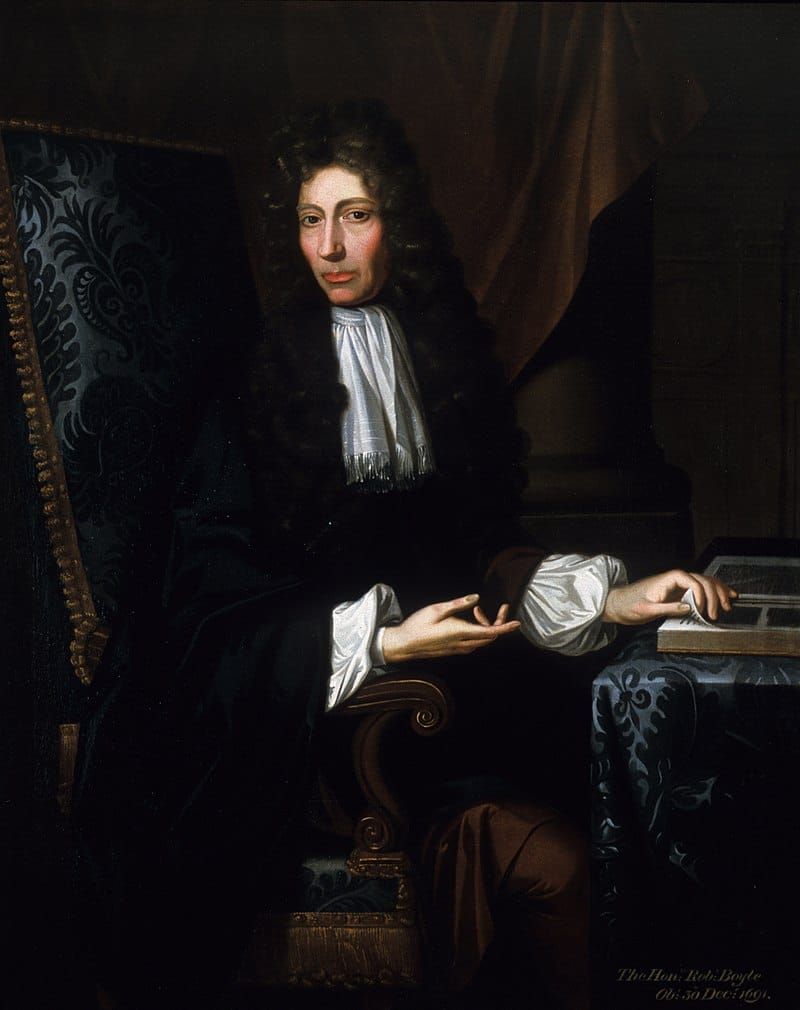
Since prehistoric times, humans have discovered, through working with metals, that some elements could be transformed into others. Thales of Miletus was the first to ask whether one substance could be transformed into another through a series of steps. If this were actually possible, then there would have to be a basic element present in all the elements. Thales believed that element to be water; in fact, his philosophical maxim was: "All is water." Anaximenes of Miletus argued that the element was air, and Heraclitus of Ephesus argued that it was fire. Empedocles, a disciple of Pythagoras, hypothesized that it could not be a single element, and therefore proposed the four basic elements: water, air, earth, and fire.
Aristotle, for his part, presented these results and added a fifth element, aether. The Greeks rejected the existence of a vacuum, and for this reason, an element between the earth and the sky was necessary. Aristotle's influence was such that for twenty centuries the conception of the composition of matter followed his rules.
Despite this, an interesting debate arose among the Greeks regarding the divisibility of matter. Some argued that matter could be divided infinitely and that any element obtained, no matter how small, could be divided again (this idea was Aristotle's). Another school of thought held that by carrying out this division one would arrive at a tiny particle, which could not be divided further; this school of thought took the name "atomism," and its main supporter was Democritus, who called those indivisible particles "atoms" and asserted that all matter was made up of atoms.
Aristotle's personality, however, was so important that he almost completely banished atomism from Greek thought; it was preserved thanks to Epicurus, whose philosophy had many followers. Another important figure, the Roman poet Lucretius of the 1st century BC, popularized atomism in a didactic form in his poem De rerum natura.
For twenty centuries, Aristotle's ideas governed scientific thought. Alchemy was the discipline that studied the transformation of certain elements into others, both to obtain specific elements, such as gold, and as a medical application, as used, for example, by Avicenna and Paracelsus. However, a singular event occurred. One of the first books published after the invention of printing was Lucretius's poem: thus atomism once again took hold throughout Europe.
A key figure of the 17th century was Robert Boyle, an English chemist who studied the transformations caused by pressure in gases. The fruit of this research was a law indicating that volume was inversely proportional to pressure, a law also discovered independently by the Frenchman Edme Mariotte, which is why it is now known as the Boyle-Mariotte law.
In 1661, Boyle wrote The Sceptical Chymist, a work that made him the father of modern chemistry. In this work, he argued that matter is composed of groups of atoms in motion, and that it is the collisions between them that give rise to the phenomena we observe. He also conducted research on the propagation of sound, relative density, and refraction in crystals, and discovered the role of oxygen in combustion and respiration.
Written by Emanuele Pace

Support independent philosophy and culture and get access to exclusive unique essays, events and workshops.
Join the movement - THELIFTEDVEIL Global Creative Media Institution
References
Leibniz. L’invenzione del calcolo infinitesimale by RBA (February 2, 2017)