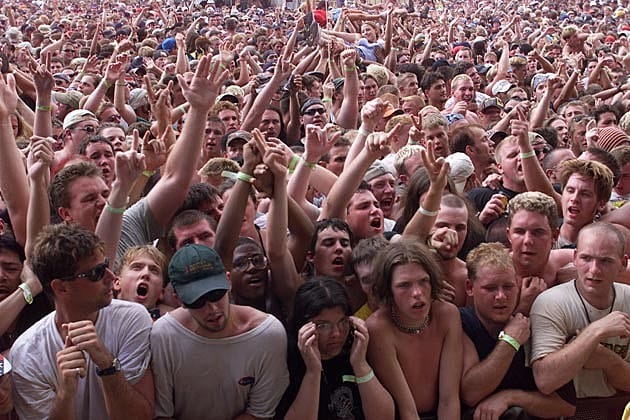
An exploration of music festivals as swarm behaviour rituals where lyrics, rhythm, and collective movement summon unity, catharsis, and cultural illusion.
Swarm behavior theory refers to the collective behaviour of decentralized, self-organized systems, typically seen in animals like flocks of birds, schools of fish, or swarms of insects. Each individual follows simple rules based on local information (e.g., alignment, cohesion, separation), leading to complex, coordinated group behaviour without a central leader. This theory is applied not only in biology but also in artificial intelligence, robotics, and economics to model and understand collective decision-making, optimization, and problem-solving in both natural and artificial systems.
What do music concerts have to share to us?
What are we articulating when we attend a concert?
What aspects of our lives unify us in that moment when we decide to attend the same event?
The lyrics of a song are the binding force, polished in objective truths, truths strong enough to gather us in large numbers, presenting joy and peace over extended periods. The alternative possibility is the spawning and activation of our will for violence, emerging and unleashing the horrors of our uncivilized primal natures, leading to a total bloody catastrophe. Yet this is not what happens. We gather and form one body, like flocks of birds with an unknown destination. Our movements are private and specific, yet they contribute to the greater good of our collective whole function, flowing from our agreed desires in that specific moment.
Animals typically group together when threats emerge, when fear of an uncertain future becomes a present reality. Danger, chaotic weather, and threats from predators are precisely what drive us to congregate. Rioting embodies swarm behaviour, while rock concerts and music festivals provide a similar unifying experience. We come together to communicate collectively, seeking relief from suffering, to exchange it for something that erodes its painful edges and elevates us back to the source of committing and enduring our lives in the human way.
Calculated Action
Man is not entirely aware of himself. In the dark halls of his inner labyrinths, he barely sees his own silhouette, perceiving his shadow as a figure to bargain with or fight. His spirit is permanently at odds. When we sing the same song at concerts, what are we expressing with those lyrics? Why do we chant in harmony?
Projections Of Ideals
Concerts and festivals are far removed from our daily routines. This is the superficial allure; people attend because their daily lives drain their exuberance and spirit. Fatigued by the turbulent weight of existence, they seek a medium to express intangible feelings, the kind buried in the 9 to 5 slave grind. Concerts are spiritual battlegrounds, where the intangible meets the physical head-on, and the experience can be exhausting. In response, people turn to places with few societal rules. Despite littering, mild violence, and petty crime, festivals offer a space for individuals to feel alive and to test their conscious personalities with substances that push the boundaries of their understood reality.
Deceived by the mystery promised by the band's enigma, they attend, and it becomes a place for threads of culture to grow, spread, and, mostly in our modernity, become poisoned.
Ultimately, these gatherings challenge our cognitive ability, allowing us to exchange old beliefs for new ones. With the aid of alcohol, drugs, and dance, the outcome is a renewed set of thoughts and outlooks. In these moments we blend together, articulating a greater message within the lyrics and the ethos of the band, using dance to finalize the expression. In our congregation, we gather to explore the threats our species faces. Notice how we dance and bombard our brains with drugs and alcohol. This is the spiritual nature of ourselves, to seek the unknown through the bombardment of the senses, to search for something we cannot translate but something we are absolutely aware of.
Behold, The Summoning Of A Species
A concert is a ritual, a space to cleanse the psyche from the sticky, static habits gathered from the external world before we return to the fundamental human condition. The process of a concert is a cultural cleansing, lived as a micro charge, something delivering motivation, inspiration, chaos, and wonder from the summoning of Dionysus. In our riddled footsteps of dance, we leave with our faces turned to the sky, clear of suffering and armoured once again with some other sprouting illusions embraced solely.
The musicians that garner the largest crowds are writing the most universally relatable songs. It is not the melody that drives people to attend these high priced locations. It is the messages behind the lyrics. Somewhere, someone has sat down and penned a message to blend with the music, broadcasting their being, thoughts, life, and soul outwardly as a spell into the world, calling others to repeat the same message. In the lure of these truths, we flock together, united under the poetry of words.
Or is it?
The music industry is the carrot to the mule. The artists are reduced to mannequins, promised the fruits of fame and glory, and by almost default position they suffer a tragically woven psychodrama between a dissociative public persona and their true nature. It is entirely corrupting to the soul. It is the devil's work, and the labels who sign the artists understand the artist is a trade off into the culture. The lyrics most of them write are tailored, socially engineered to spark trends and affect the stability of the citizens cultural life, setting new movements and steering the psyches of the youth into lanes imposed by the label.
Here, we form a decentralized body, but under the direction of the singer and their band, we submit to the magnetism of the imagery cast out by the singer. As they pass through the colours and sequences of their lyrics and melody, the collective is submerged under the seduction of spells, synchronized in their timing.
And yet, we synchronize our bodies in motion. As time progresses, human cultures evolve, and we establish new status quos for our movements, imitating the latest trends. Through dancing, many have created newly designed moves that ripple out to be considered cool, trendy, attractive, and as representations of our worldviews.
The similar dances shared by many around the same musical beat indicate that we are moving and operating in synchronicity. Not like the army of a dictatorship during a military parade, but rather, we are engaging in a show of force that creates fundamental human experiences: bliss, peace, and positive emotions. We share these here to heal ourselves from the strangeness of the modern world.
In time, festivals and concerts demonstrate the human inclination for leadership, leadership that does not follow the standards of politics, nor one that imposes pressure on our livelihood. Instead, it is a leadership that guides the spirit, engaged through dance, celebration, ritual, and movement, free from force, order, illusion, hypocrisy, and self-destructive tendencies. These destructive forces are often summoned by those seeking to degrade themselves, acquiring a sense of inferiority through the idealized presentations of bandmates, singers, and a culture hedonistically driven to diminish one’s inner power.
Support independent philosophy and culture and get access to exclusive unique essays, events and workshops.
Join the movement - THELIFTEDVEIL Global Creative Media Institution


Comments ()