
A personal story that leads to a meditation on death...
Exactly one day before my birthday, I contracted mold poisoning. A pillow I washed had failed to properly dry, and having been in my room for a select number of days, the mold began to fester and grow. Soon enough, there was a tightness in my chest, and the air was moist and suffocating. It wasn't long before I found the source of the problem, but by then it was too late: the spores had entered my body, and I was poisoned.
The days that ensued were among the worst of my life. Breathing had become a privilege, a wink of sleep along with feverish nights became the norm, and the hope of a long rest became synonymous with a far-off dream. The night sweats, headaches, and blurred vision all congealed into a single, hazy experience. It was then, at my worst hour, that I achieved a new level of understanding about mortality: the literature I read about death and the potential meaning it gives to human life had another dimension to it, and to understand the words beyond words, one has to be put in a position where life can easily slip away.
Suddenly, the world became vain. My essays, my social media accounts, Substack, and my dreams became frivolous in the face of eternity. All human projects were. I had finally felt what I had long since read about: dread and the confrontation of my own death; not merely the kind of death that happens to others, but the end of the road of life for me.
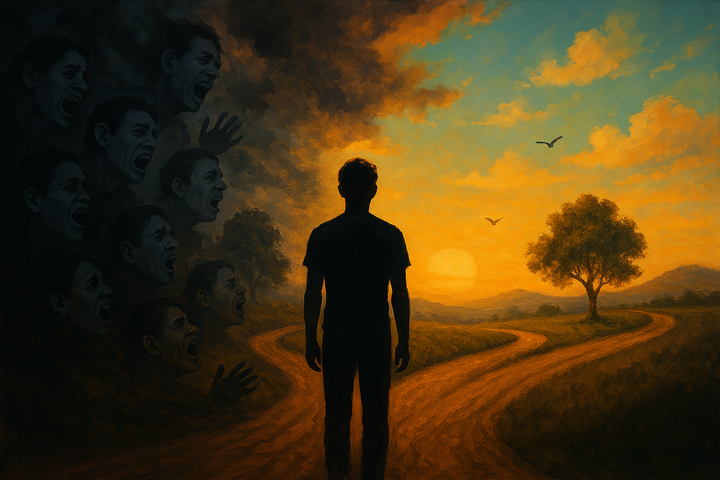
My fevers worsened, and my chest continued to tighten, and it was then that I felt the wisdom of the fool and not the philosopher. The wisdom of the fool pushes back the knowledge of death. The philosopher wants to conquer or confront mortality, but the fool turns away. It is hasty to judge the fool too hard for a game everyone has played, but in such a common game, perhaps there is value. A strange, bewildering, and even frightening space opened up for me—I had, for the first time in my life, really confronted death, and all I could do was cling to and quench my thirst for life.
The problem was I didn't know how, other than to love my life right then and there. If fate had willed my life to be snuffed out, then so be it. I steeled myself for the worst, but despite the pains, I still preferred to live. Then, the fool made room for the philosopher, and as I lay in bed, a single paragraph popped into my head from a book I read some time ago.
The line was from Derrida's (2008) essay, The Gift of Death, where he says "Death is very much that which nobody else can undergo or confront in my place. My irreplaceability is therefore conferred, delivered, 'given,' one can say, by death" (p. 42). The ancients may be correct in saying death should not be feared, but to see it as a gift that confirms our irreplaceability is quite another thing entirely.
No one can take our place and die for us; and if they tried, they would be delaying the only true democratic end that every person on Earth will meet, but not stopping it. That is the reason why death cements our specialty, because our own is unavoidable. It is the end of the road, the 'undiscovered country,' a place that cannot be reached in life yet must still be reconciled with it and within it—death is intertwined with life, and curiously, it is open to understanding only in life and never in itself.
While feverish and delusional, I pondered Derrida's insights, and I realized no one can take my soul away, and the same stands true for my death. My soul, as in my personhood and being, is uniquely my own—and while I felt the cold stare of death and shuddered at the thought of leaving all that is known, I finally understood my relationship with it. It is not just that death is a gift, as Derrida would have it, or that it gives the hourglass of our lives meaning, but before death can be configured and interpreted profoundly, one must come to realize their mortality, like in Heidegger's teachings.
However, reading is never enough to fully understand it, as it can't be fully understood. A special non-inferential connection must be made between death and the self, one that can only exist between the space of an individual life and eternal rest. It is a conclusion and realization that can't be made by anyone but you, perhaps brought by a brush with death or when one feels their life slipping away. This sentiment ties back to the Gift of Death, and it can be said that one of death's many gifts must also be its powers of indirect education.
As obvious as it may be, I did not die; but I feel as if a part of me did. Something curious happened: the initial fear of death I felt had smoothed into accepting the idea of it. The fool allowed the philosopher to inhabit his space, and what came out of this is that I gained a greater appreciation of life, as well as a deep respect for death. There is nothing quite like a brush with death to rattle the tree of life and allow it to reach new heights.
Support independent philosophy and culture and get access to exclusive unique essays, events and workshops.
Join the movement - THELIFTEDVEIL Global Creative Media Institution
References
Derrida, J. (2008). The gift of death & literature in secret (2nd ed.). The University of Chicago Press.
Written by Rex Eloquens

Comments ()