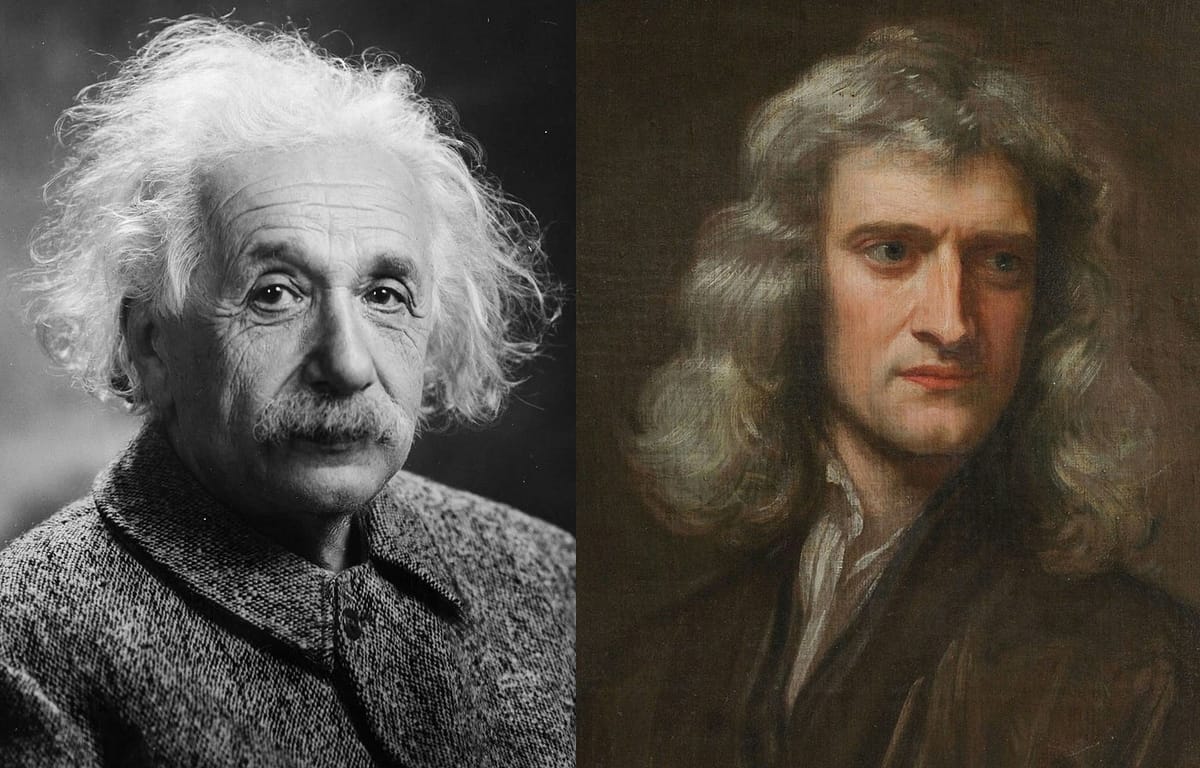
A comparative meditation on how Einstein and Newton. Two unmatched giants of physics rose to genius through entirely different lives, pressures, and intellectual temperaments.
Albert Einstein and Isaac Newton are unquestionably the greatest physicists of all time. However, despite this similarity, there are fundamental differences between the two thinkers, both personally and intellectually.
The first notable difference concerns their personal situations: rejected by the academic community after graduating from the Polytechnic Institute of Zurich in 1900, by 1905 Einstein was already a married man and the father of a one-year-old child, obliged to fulfill the onerous responsibilities of a full-time job at the Swiss Patent Office.
Newton never married (perhaps even died a virgin), and in 1666 he had just obtained his bachelor's degree, but he was still what we would call a "graduate student." In fact, he had been temporarily relieved of his academic responsibilities due to the closure of Cambridge University after the outbreak of the Black Death.
Another difference concerns their standing within the scientific world. Newton had not published anything before 1666, while Einstein had already published five extraordinary papers in the prestigious journal Annalen der Physik. Thus, if 1666 marks the explosion of Newton's genius and the beginning of his independent research, 1905 represents the date when Einstein's already mature genius manifested itself to the world with a series of works of historic importance. None of Newton's research in 1666 resulted in rapid publication. The reasons for Newton's disinterest in official recognition have long been the subject of psychological, or even psychopathological, speculation.
Several years passed before Einstein's achievements were recognized by the scientific community. But the process began almost immediately, in 1905; in 1909, Einstein was appointed to the newly created chair of associate professor of theoretical physics at the University of Zurich, and was invited to give a lecture at the annual congress that brought together all members of the German-speaking scientific community.
Thus, if 1905 marks the beginning of Einstein's rise as a leading figure within the physics community, Newton remained voluntarily in the shadows until well after 1666. Only in 1669, when, under pressure from friends, he authorized the limited circulation of a mathematical manuscript that made public some parts of the calculus he had developed, did the anonymity in which he had until then found himself begin to dissolve.
Another notable difference between the two scientists lies in their mathematical abilities. Newton demonstrated his great mathematical talent from the very beginning, developing the mathematical apparatus necessary to develop his ideas regarding mechanics and gravitation. Einstein, though capable as a student and practitioner, never displayed true mathematical creativity. Fortunately, to complete his 1905 work, he did not require any mathematical knowledge beyond what he had learned in school. However, it fell to Henri Poincaré, Hermann Minkowski, and Arnold Sommerfeld to provide the most appropriate mathematical formulation for the theory of special relativity.
To sum up, in the case of Newton, in 1666 we have a scholar who worked solely for personal pleasure, a mature mathematical genius, whose activity in the field of physics, however, was still at a larval stage.
In Einstein's case, in 1905 we have a man worrying about supporting his family and practicing a practical profession, forced to fit physics into the gaps of an already fully occupied life, and yet already a master of theoretical physics ready to demonstrate his genius to the world.
Written by Emanuele Pace

Support independent philosophy and culture and get access to exclusive unique essays, events and workshops.
Join the movement - THELIFTEDVEIL Global Creative Media Institution
References
L'anno memorabile di Einstein. I cinque scritti che hanno rivoluzionato la fisica del Novecento edited by John Stachel (First published: 2001)



Comments ()